






PlasmaGlow
PlasmaGlow: Plasma Skin Regeneration Treatment in Singapore
PlasmaGlow harnesses plasma energy — ionised gas that exists at a fourth state of matter — to trigger deep skin regeneration without the use of traditional lasers. If you’re seeking a non-laser skin resurfacing option in Singapore that addresses eyelid tightening, surface irregularities, fine lines, or skin renewal at the cellular level, PlasmaGlow may be a meaningful option to explore with your doctor.
At SW1 Clinic, PlasmaGlow is used by our medical team to support genuine skin regeneration and not just surface-level refinement. The plasma energy creates a precise, controlled injury at the skin surface that activates the body’s own healing and regeneration mechanisms. Many patients notice progressive renewal in skin quality, tone, and firmness over the weeks following treatment, as new healthy skin cells replace damaged or aged tissue.
Understanding Plasma Energy and How PlasmaGlow Works
Plasma is not a laser, not a radiofrequency device, and not an ultrasound machine. It occupies its own category in energy-based skin treatment. Understanding why matters if you’re researching your options.
Plasma is created when a gas (in this case, nitrogen or atmospheric air) is electrically ionised, converting it into a high-energy state that can interact with living tissue in a uniquely precise way. When applied to the skin at a controlled intensity, plasma energy causes sublimation — a process where the outermost skin cells transition directly from solid to gas without burning through deeper tissue in an uncontrolled manner. This creates an extremely precise zone of controlled regeneration.
What follows is the skin’s own healing response: a cascade of cellular regeneration, collagen synthesis, and tissue renewal that, over weeks, produces new, healthier skin. This is the heart of PlasmaGlow — it is fundamentally a skin regeneration treatment, not simply a tightening or resurfacing modality.
At SW1 Clinic, our doctors apply PlasmaGlow with precision mapping of the treatment area. The depth, intensity, and pattern of application are personalised to your specific skin concerns, whether that’s fine lines around the eyes, loose skin on the upper eyelids, uneven texture, or broader surface renewal on the face.
Skin Regeneration with PlasmaGlow: What It Addresses
SW1 Clinic is known for selecting treatments that produce meaningful biological change and not just superficial effects. PlasmaGlow’s strength lies in skin regeneration: the process of replacing aged, damaged, or irregular skin with renewed, healthier tissue. This is distinct from treatments that simply tighten existing collagen or temporarily plump the skin.
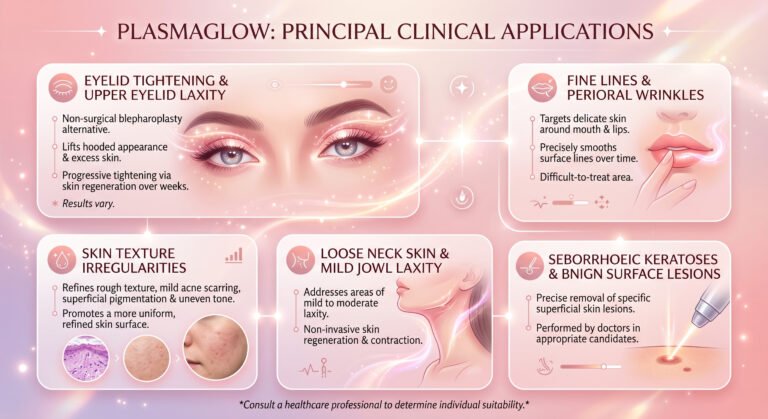
PlasmaGlow can be particularly effective for:
- Eyelid tightening and upper eyelid laxity: One of PlasmaGlow’s most clinically notable applications is the non-surgical tightening of the upper eyelid. As skin around the eyes loses elasticity, many patients develop a hooded appearance or excess skin at the upper lid — a concern that has traditionally required surgical blepharoplasty. PlasmaGlow offers a non-surgical alternative that many patients find meaningful, with progressive tightening occurring as skin regeneration unfolds over several weeks. Results vary and individual anatomy will influence outcomes.
- Fine lines and perioral lines: The delicate skin around the mouth and lips is difficult to treat with many energy devices. PlasmaGlow’s precision makes it well-suited to targeting fine lip lines and perioral wrinkles, where skin regeneration can visibly smooth the surface over time.
- Skin texture irregularities: Including rough texture, mild acne scarring, superficial pigmentation, and uneven skin tone. The skin regeneration process initiated by plasma energy can lead to a more uniform, refined surface.
- Loose neck skin and mild jowl laxity: PlasmaGlow can address areas of mild to moderate laxity where skin regeneration and contraction are desired without invasive procedures.
- Seborrhoeic keratoses and benign surface lesions: Plasma energy is used by our doctors for the precise removal of certain superficial skin lesions in appropriate candidates.
For patients with more significant structural laxity — deeper sagging, significant jowling, or midface descent, PlasmaGlow works well as part of a combined approach with complementary treatments (see below).
Not sure which treatment is right for you? Take the SW1 Quick Skin Quiz — a 2-minute skin diagnostic designed by our doctors.
PlasmaGlow vs Laser Resurfacing: What's the Difference?
Many patients come to us having researched laser skin resurfacing and wanting to understand how PlasmaGlow compares. It’s a fair and important question.
Laser resurfacing uses focused light energy to heat and ablate the skin at varying depths — ablative lasers remove the outer skin layer, while non-ablative lasers target deeper tissue without breaking the surface. Both approaches trigger collagen remodelling and skin renewal, but they work through photochemical and photothermal mechanisms.
PlasmaGlow uses plasma energy, a fundamentally different mechanism to sublimate surface skin cells and trigger regeneration without the light-based interaction that defines laser treatment. This has several practical implications for patients considering their options:
- No risk of pigmentation from laser scatter a relevant consideration for Asian skin tones common in Singapore, where post-inflammatory hyperpigmentation from laser treatments can be a concern
- Highly targeted application plasma can be precisely directed to very small areas (like the eyelid margin) without affecting surrounding tissue
- Non-laser classification PlasmaGlow may be a suitable option for patients who have been advised that certain laser treatments are not appropriate for their skin type
That said, laser treatments have their own significant strengths, and the “right” approach depends entirely on your skin’s needs. Our doctors will advise honestly on which modality best suits your concerns during consultation.
The Skin Regeneration Timeline: What to Expect After PlasmaGlow
Skin regeneration is not an instant process — and this is worth understanding before your treatment, so you can plan appropriately.
Immediately after PlasmaGlow, treated areas will show small carbon dots (the sublimation points) and redness. Mild swelling, particularly around the eyes if that area was treated, is common and typically resolves within several days. The carbon dots slough off naturally over three to five days as new skin begins to form beneath.
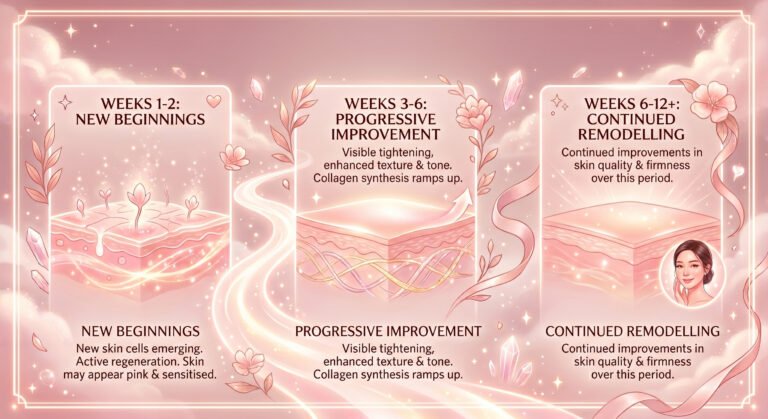
The skin regeneration process continues over the following weeks:
Week 1–2: New skin cells emerging. Skin may appear pink or sensitised as regeneration is active.
Week 3–6: Progressive improvement in texture, tone, and tightening becomes visible as collagen synthesis ramps up.
Weeks 6–12+: Continued remodelling, with many patients noticing ongoing improvements in skin quality and firmness over this period.
Downtime is a realistic consideration. Most patients at our Paragon clinic plan for five to seven days of visible recovery before returning to full social activity following a moderate-intensity PlasmaGlow treatment. Your doctor will discuss this with you in detail based on the area and intensity of treatment planned.
Sun protection and a careful post-treatment skincare routine are essential to support skin regeneration and protect the new skin forming after PlasmaGlow.
Combining PlasmaGlow with Complementary Treatments
What sets SW1 apart is our commitment to designing treatment plans that address your full picture of skin concerns — not just applying one solution and hoping it covers everything.
PlasmaGlow’s skin regeneration capability at the surface level pairs naturally with treatments that address deeper structural concerns. For patients with significant facial volume loss or deeper laxity, Revitalift Face can restore the volumetric support that skin regeneration alone cannot replace. For patients with deeper tissue sagging, Thermatight monopolar radiofrequency can target the deeper fat and SMAS layers, complementing PlasmaGlow’s surface regeneration with a structural lift from below.
Your doctor will map out a combination approach, sequencing treatments to maximise your results while managing recovery time.
*Clinical results may vary depending on individual skin conditions and baseline health.
FAQS
Is PlasmaGlow the same as a plasma pen I can buy online?
No — and this distinction matters. Consumer-grade plasma pens vary widely in quality, calibration, and safety. At SW1 Clinic, PlasmaGlow is performed by our doctors using medical-grade plasma devices calibrated for precise energy delivery. The treatment protocol, depth settings, and aftercare are all managed by clinically trained professionals. Home devices carry risks of burns, scarring, and pigmentation when misused.
How effective is PlasmaGlow for eyelid tightening?
PlasmaGlow is one of the more established non-surgical options for addressing mild to moderate upper eyelid laxity. Many patients notice meaningful tightening and a reduction in hooding as skin regeneration progresses over six to twelve weeks. Results vary depending on the degree of laxity, your skin’s regenerative response, and individual anatomy. Your doctor will assess whether your concerns are likely to respond well during consultation.
Is PlasmaGlow suitable for all skin types?
PlasmaGlow can be used across a range of skin types, but skin tone, thickness, and history of pigmentation are all factors your doctor will assess. We see a high proportion of patients with Asian skin at our Singapore clinic, and our doctors are experienced in calibrating PlasmaGlow treatments to minimise pigmentation risk for darker skin tones. Not all skin types are equally suited to every energy level and this is discussed honestly during consultation.
How long do PlasmaGlow results last?
As with all skin regeneration treatments, results are not permanent in the sense that ageing continues after treatment. Many patients enjoy visible improvement for twelve to twenty-four months following treatment. Maintenance sessions and a supportive skincare regimen help sustain the regeneration benefits over time.
What is recovery like after PlasmaGlow?
Expect visible downtime, particularly if the eyelid or full face is treated. The carbon dots formed during treatment are visible for approximately three to five days and will gradually slough off. Redness and mild swelling are common in the first few days. Most patients plan for five to seven days before resuming full social or work activity. Your doctor will give you detailed post-treatment instructions including gentle cleansing, healing ointments, and strict sun protection.
Book a Consultation
If you’d like to explore whether PlasmaGlow is the right skin regeneration treatment for your concerns, our doctors at SW1 Clinic are here to guide you.