






Airbrush FX Dual Laser

Airbrush FX Dual Laser: Two Wavelengths, One Exceptional Result
The idea of glass skin — the kind of poreless, luminous, apparently filterless complexion that fills certain corners of social media is, for most people, not achieved with a single product or treatment. It is the result of addressing multiple concerns at once: the deep scars that alter skin’s topography, the surface pigmentation that creates unevenness, the dullness that comes from accumulated sun damage and slow cellular turnover. Airbrush FX Dual Laser was designed to work on all of these simultaneously — two precisely chosen wavelengths, one treatment session, results that look like very good skin rather than very obvious intervention.
The Dual-Wavelength Advantage: Surface and Depth Together
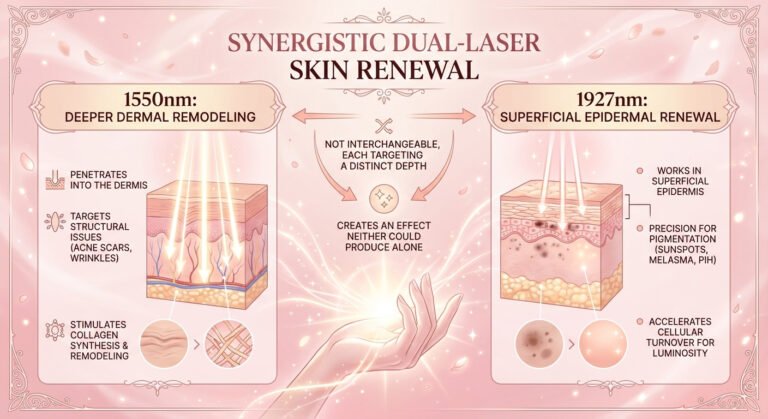
The defining transformation of Airbrush FX is the combination of two complementary laser wavelengths in a single treatment: 1550nm and 1927nm. They are not interchangeable — each targets a distinct depth and mechanism, and together they create an effect that neither could produce alone.
The 1550nm wavelength penetrates deeper into the dermis, targeting the structural layer where acne scars form, where wrinkles embed, and where collagen loss begins. It stimulates dermal remodelling and new collagen synthesis — the foundational repair work that addresses textural concerns at their source.
The 1927nm wavelength, by contrast, works primarily in the superficial epidermis. It is a precision instrument for surface pigmentation: sunspots, melasma, post-inflammatory hyperpigmentation, the general brownish unevenness that accumulates over years of sun exposure. It also improves overall skin luminosity by accelerating cellular turnover in the outermost layers.
“The dual-wavelength approach means we can address things in the same session that would previously have required two separate laser appointments,” says Dr Low Chai Ling. “Fewer total sessions, more complete results — that’s genuinely better medicine.”
Micro-Thermal Treatment Zones: The Science of Fractional Healing
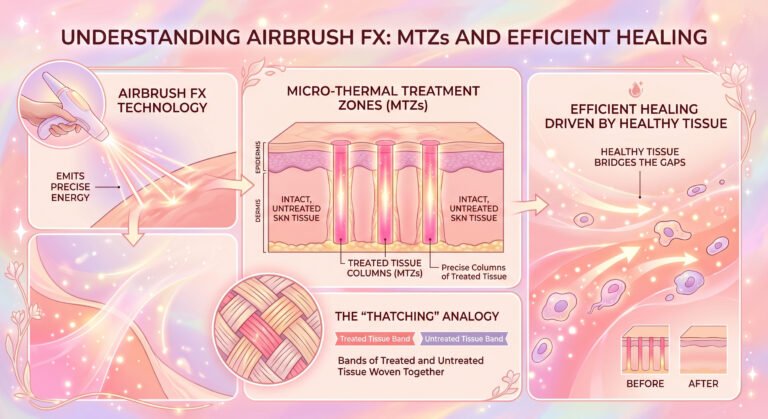
Like other fractional lasers, Airbrush FX creates Micro-Thermal Treatment Zones (MTZs) — precise columns of treated tissue surrounded by intact, untreated skin. The comparison is sometimes made to thatching: bands of treated and untreated tissue woven together, the healthy tissue bridging the gaps and driving efficient healing.
These microscopic pillars of intact skin are what make fractional resurfacing so much gentler in recovery than fully ablative approaches. The body has an intact scaffold from which to mount its healing response, with growth factors, stem cells, and keratinocytes from the untreated zones migrating into the treated areas. “The density and depth of the MTZs is something we calibrate to the individual patient,” notes Dr Chua. “It is not a one-size-fits-all setting.”
Not sure which treatment is right for you? Take the SW1 Quick Skin Quiz — a 2-minute skin diagnostic designed by our doctors.
Active Acne and Oil Gland Reduction: An Unusual Advantage
One of the more surprising capabilities of Airbrush FX is its ability to reduce active acne — something that distinguishes it from most other resurfacing lasers. The 1550nm wavelength, at appropriate energy settings, can target the sebaceous glands within the dermis, reducing their activity and lowering sebum output over time. For patients with oily, breakout-prone skin who are also seeking scar revision, this dual benefit — treating existing damage while reducing the conditions that cause new damage — is clinically and practically valuable.
This also means Airbrush FX can be used on patients with some level of active acne, whereas traditional ablative resurfacing on inflamed skin carries greater risk of post-treatment complications.
Actinic Keratosis and the Health Benefit Beyond Aesthetics
For older patients or those with significant sun exposure history, Airbrush FX offers a benefit that extends beyond appearance. Actinic keratoses — rough, scaly patches of skin caused by years of UV damage, which carry a risk of progression to squamous cell carcinoma — respond to the 1927nm wavelength, which clears these precancerous lesions as part of the resurfacing process.
This positions Airbrush FX as a treatment with genuine preventive health value for the right patient population, not purely a cosmetic intervention. “For patients in their forties and fifties with significant sun damage history, we are sometimes managing both aesthetic and medical concerns in the same session,” says Dr Lee.

Social Downtime: The Weekend-Ready Recovery
Airbrush FX occupies a particularly appealing middle ground on the downtime spectrum. It is not a zero-downtime treatment — patients can expect some degree of pinkness and mild swelling for twenty-four to forty-eight hours post-treatment, and the skin may have a subtle texture as the MTZs heal. But there is no raw, oozing skin, no significant crusting, and no period of looking visibly unwell.
Most patients describe this as “social downtime” — a Saturday afternoon treatment that leaves them comfortable and presentable for Monday. The skin has a slightly flushed, just-exercised appearance rather than the more dramatic visual of an ablative recovery. A gentle skincare routine and diligent SPF application are all that is required. LED Red Photomodulation in the days following treatment accelerates the resolution of pinkness and supports the skin’s healing.
*Clinical results may vary depending on individual skin conditions and baseline health.
FAQS
How is Airbrush FX different from a single-wavelength fractional laser?
The dual-wavelength system addresses both deep dermal concerns (scars, wrinkles, collagen loss) and superficial epidermal concerns (pigmentation, dullness, surface texture) in a single session. A single-wavelength fractional laser typically focuses on one depth, requiring a separate treatment for the other concern.
Can Airbrush FX treat melasma?
The 1927nm wavelength targets surface pigmentation and can improve melasma, though melasma is a complex condition that often requires a multi-modal approach. A consultation will determine whether Airbrush FX is appropriate as a standalone or combination treatment for your specific melasma presentation.
Is it suitable for all skin tones?
The Airbrush FX parameters can be adjusted for different skin types, but as with all laser resurfacing treatments, some skin tones require more conservative settings to minimise the risk of post-inflammatory hyperpigmentation. Your SW1 doctor will assess your Fitzpatrick skin type and recommend the appropriate protocol.
How many sessions are recommended?
Most patients achieve their goals with two to four sessions spaced four to eight weeks apart. The number depends on the severity of concerns being addressed and individual healing response.
When will I see the full results?
Some improvement in skin tone and glow is typically visible within a week of treatment. The deeper remodelling effects — scar improvement, collagen synthesis — continue to develop over three to six months following each session.
Book a Consultation
If your skin concerns include more than one category — scars and pigmentation, texture and dullness, active acne and existing damage, Airbrush FX may be the most efficient path to the comprehensive result you are looking for. The SW1 team can assess your concerns and design a treatment programme around them.