





PlasmaGlow Eyelift
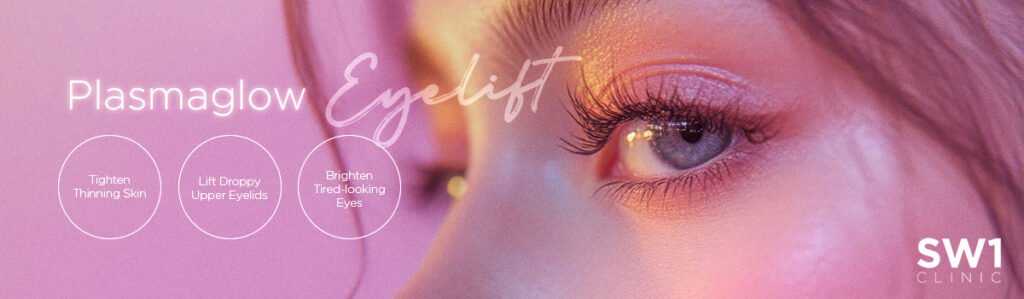
PlasmaGlow Eyelift: Medical-Grade Nitrogen Plasma for Crepey Eyelids
Not every skin concern around the eyes is best addressed with a laser. For patients with crepey, paper-thin eyelid skin — particularly the fine wrinkling that forms on the upper lid and the loose, textured skin beneath the eyes — PlasmaGlow Eyelift at SW1 Clinic offers a fundamentally different approach. Using medical-grade nitrogen plasma energy rather than light, PlasmaGlow Eyelift stimulates deep skin regeneration while keeping the skin surface intact throughout healing. At our clinic, this non-laser treatment is used to address crepey texture, skin laxity, and fine wrinkling in a 360-degree treatment covering upper and lower eyelids right to the lash line.
Why Nitrogen Plasma — Not Laser — for Crepey Eyelid Skin
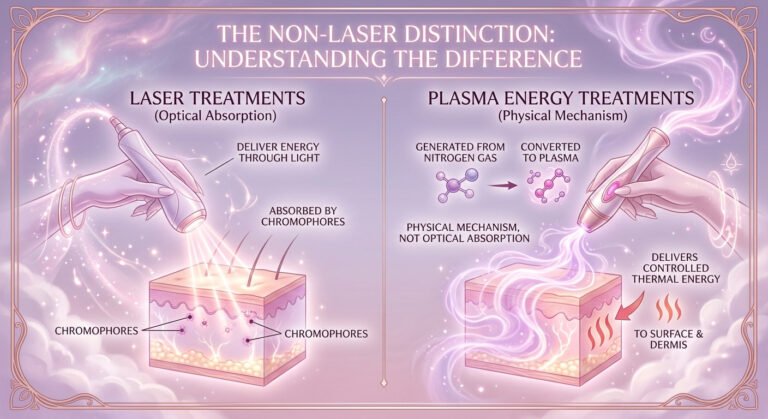
The “non-laser” distinction is clinically meaningful. Laser treatments deliver energy through light absorbed by chromophores in the skin. Plasma energy works differently: it is generated from nitrogen gas that is converted into a plasma state, delivering controlled thermal energy to the skin surface and dermis through a physical mechanism — not optical absorption.
This has several practical implications for eyelid treatment:
1. Tissue-selective heating without light scatter. Plasma energy deposits heat in a controlled pattern without the lateral scatter that can occur with some laser wavelengths in thin tissue. For the extremely thin skin of the eyelids, this precision matters.
2. Independent of skin pigmentation. Unlike laser treatments where energy absorption varies with melanin concentration — a key concern for Asian skin phototypes in Singapore — nitrogen plasma energy is not chromophore-dependent. This means the treatment can be performed more consistently across different skin tones.
3. The “biological dressing” effect. One of the unique characteristics of nitrogen plasma treatment is that the treated skin surface remains structurally intact during healing. Rather than ablating and removing the epidermis as a conventional laser does, plasma energy causes the surface cells to desiccate in place. This desiccated layer acts as a natural “biological dressing” — protecting the underlying healing dermis from infection and trauma while new collagen forms beneath. Infection risk is meaningfully reduced compared with fully ablative resurfacing.
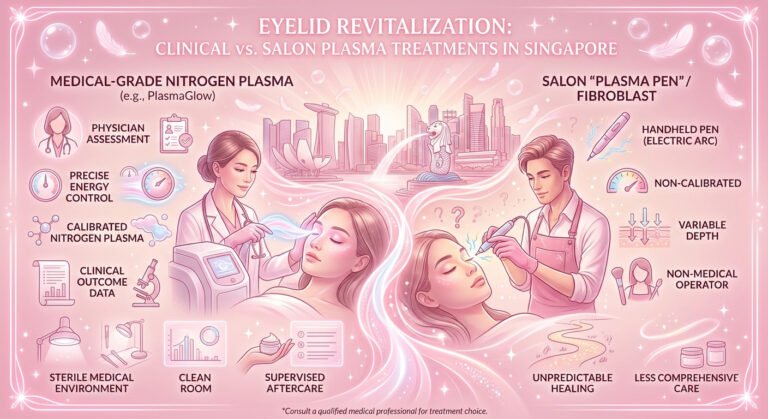
SW1 Clinic is known for its careful patient selection and medical-grade approach to plasma treatments. It is important to distinguish PlasmaGlow from the salon-based “plasma pen” or “fibroblast therapy” devices that have proliferated in non-medical settings — PlasmaGlow uses certified medical-grade nitrogen plasma technology operated exclusively by trained aesthetic physicians.
The 360-Degree Eye Treatment: Upper and Lower Lids to the Lash Line
PlasmaGlow Eyelift is distinguished by its ability to treat the full circumference of the periorbital area — upper and lower eyelids — right up to the lash margin. Many treatments are limited in how close they can be applied to the lashes; the controlled precision of nitrogen plasma allows treatment of even the finest, most delicate skin directly adjacent to the lashes.
Areas addressed in a full PlasmaGlow Eyelift session may include:
- Upper eyelid: excess and crepey skin contributing to hooding and heaviness
- Crease of the upper lid: fine horizontal wrinkling in the skin fold
- Lower eyelid: crepey texture and fine wrinkling of the under-eye skin
- Tear-trough adjacent area: generalised laxity and textural irregularity
- Outer corners: crow’s feet extending onto the eyelid skin
This 360-degree coverage can transform the overall quality of periorbital skin in a single treatment session.
Not sure which treatment is right for you? Take the SW1 Quick Skin Quiz — a 2-minute skin diagnostic designed by our doctors.
Medical-Grade Nitrogen Plasma: A Critical Distinction
Patients researching plasma eyelid treatments in Singapore will encounter a range of options, from registered medical devices operated by physicians to handheld “plasma pens” used at beauty salons or by non-medical practitioners. This distinction carries genuine clinical significance.
Medical-grade nitrogen plasma (PlasmaGlow):
- Generates nitrogen plasma via a clinical device with precise energy control
- Parameters adjusted by a physician based on individual skin assessment
- Consistent, calibrated energy delivery with clinical outcome data
- Performed in a sterile medical environment by an aesthetic physician
- Comprehensive aftercare protocol supervised by medical staff
Salon “plasma pen” or “fibroblast” devices:
- Handheld devices generating plasma via an electrical arc to the skin surface
- Not calibrated for consistent depth or energy delivery
- No clinical outcome data equivalent to medical-grade devices
- Often performed by non-medically trained operators
- Variable and unpredictable healing profiles
At SW1 Clinic’s Paragon clinic, every PlasmaGlow Eyelift session is physician-planned and physician-operated. The difference is not cosmetic — it is the difference between a medical procedure and an unregulated beauty treatment.
What to Expect After PlasmaGlow Eyelift
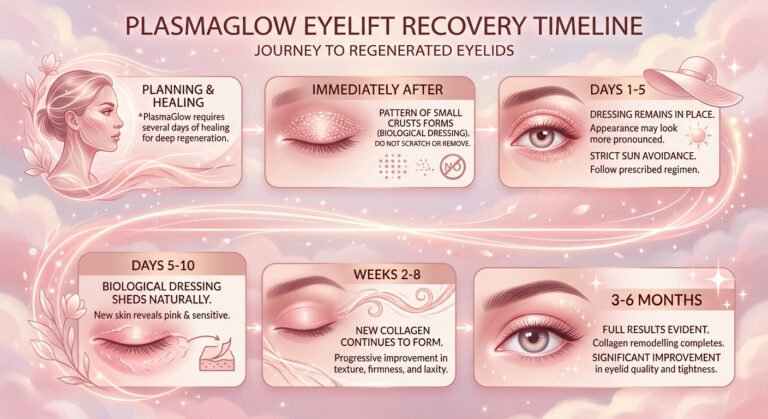
PlasmaGlow Eyelift involves a recovery period that patients should understand and plan for. Unlike light-touch treatments, the depth of skin regeneration achievable with nitrogen plasma requires several days of healing.
Immediately after: Treated areas appear with a pattern of small crusts or dots — the desiccated skin cells that form the biological dressing. These should not be removed or scratched.
Days 1–5: The biological dressing remains in place. The area may look more pronounced before it begins to improve. This is a normal part of the healing process. Strict sun avoidance and the prescribed aftercare regimen must be followed.
Days 5–10: The biological dressing gradually sloughs off naturally, revealing new, regenerated skin beneath. This skin will initially appear pink and sensitive.
Weeks 2–8: The new skin matures and new collagen continues to form. Progressive improvement in eyelid texture, firmness, and laxity is typically apparent.
3–6 months: Full results are evident as collagen remodelling completes. Many patients notice a significant improvement in eyelid quality, tightness, and the appearance of crepey texture.
For comprehensive periorbital rejuvenation, PlasmaGlow Eyelift can be combined with Revitalift Eyes for volume restoration, or with Ultherapy Prime brow lift to address brow descent contributing to upper lid heaviness.
Who Is PlasmaGlow Eyelift Most Suitable For?
PlasmaGlow Eyelift is particularly well-suited for patients who:
- Have prominent crepey texture on the upper or lower eyelid skin
- Have mild to moderate eyelid laxity with skin quality concerns as a primary issue
- Are not yet candidates for surgical blepharoplasty but want meaningful skin regeneration
- Have not responded adequately to lighter laser or RF treatments for the eye area
- Are willing to plan for the healing period required
- Want to avoid laser treatment due to concerns about pigmentation risk (Asian skin)
Your physician at SW1 Clinic will conduct a thorough periorbital assessment to determine whether PlasmaGlow Eyelift, or a combination approach, is the most appropriate path for your goals.
*Clinical results may vary depending on individual skin conditions and baseline health.
FAQS
How long is the recovery after PlasmaGlow Eyelift?
Most patients require 7–10 days of social downtime as the biological dressing forms and resolves. The full healing and result timeline extends to 3–6 months. Your doctor will discuss the recovery process in detail during your consultation and provide a comprehensive aftercare protocol.
Is PlasmaGlow Eyelift the same as a "plasma pen" treatment?
No. PlasmaGlow uses certified medical-grade nitrogen plasma technology operated by trained aesthetic physicians. Salon “plasma pen” or “fibroblast” devices are handheld electrical arc devices with no equivalent clinical safety profile or outcome data. The distinction is clinically significant.
Is PlasmaGlow Eyelift safe for Asian skin?
Nitrogen plasma energy is not chromophore-dependent, meaning it does not interact with melanin in the way laser treatments do. This generally makes it more consistent across different skin phototypes including Asian skin. Your physician will assess your skin type and advise on suitability.
How many sessions of PlasmaGlow Eyelift are typically needed?
Many patients achieve their desired outcome with a single session. The depth of regeneration possible in one PlasmaGlow session is typically greater than achievable with a single laser session. Your doctor will assess the severity of your concerns and advise accordingly. Results vary by individual.
Can PlasmaGlow Eyelift treat the skin right up to the lashes?
Yes. One of the distinguishing features of the PlasmaGlow Eyelift technique is its ability to safely treat the eyelid skin right up to the lash margin, allowing treatment of the finest eyelid skin in the 360-degree periorbital zone.
Book a Consultation
Book your PlasmaGlow Eyelift consultation at SW1 Clinic.