







Tattoo Removal Laser
Laser Tattoo Removal Singapore: Picosecond Technology for Multi-Colour Ink
Tattoos tell a story — but sometimes the story changes, and the desire to move on is entirely understandable. Laser tattoo removal in Singapore has advanced considerably beyond the slow, blister-prone treatments of a decade ago. At SW1 Clinic, we use a combination of picosecond and nanosecond laser technology to shatter tattoo ink into microscopic dust-like particles, allowing the body to clear them more efficiently and with a more comfortable recovery profile. Whether you are addressing a single small tattoo or multiple pieces across different areas, our approach is calibrated to the specific ink colours, skin tone, and individual clearance response that make each tattoo removal journey unique.
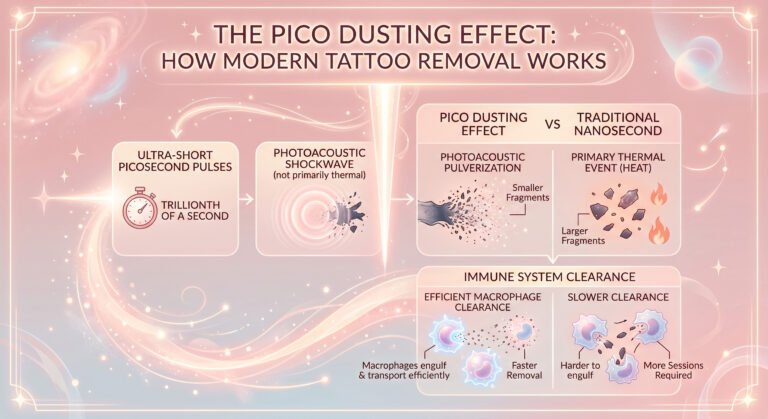
The PICO Dusting Effect: How Modern Tattoo Removal Works
The central advance in modern tattoo removal is the picosecond pulse, an ultra-short laser pulse lasting one trillionth of a second. The speed of this pulse creates a photoacoustic shockwave rather than a primarily thermal event, which shatters tattoo ink particles into a cloud of dust-like fragments through a process known as photoacoustic pulverization.
This PICO Dusting Effect is significant because of particle size. When ink is shattered into smaller fragments, the body’s macrophages — the immune cells responsible for clearing foreign particles — can engulf and transport them far more efficiently. Traditional nanosecond lasers, which work primarily through heat, break ink into larger fragments that take longer to clear and require more sessions to achieve the same degree of fading.
The dual-technology approach used at SW1 Clinic — combining the shattering power of picosecond pulses with the safety and versatility of nanosecond pulses — allows our doctors to optimise for both efficiency and skin safety at every session.
The 694nm Ruby Laser: Targeting Blue and Green Ink
One of the most persistent challenges in tattoo removal is the clearance of blue and green ink pigments. These colours are notoriously difficult to target with standard Nd:YAG lasers because their absorption spectra do not align well with the most common laser wavelengths.
The 694nm Ruby laser wavelength is specifically absorbed by blue and green pigment chromophores — making it the gold standard for tattoo ink colours that other lasers struggle to clear. At SW1 Clinic, the incorporation of a 694nm Ruby laser component alongside picosecond and nanosecond technology means that even multi-colour tattoos containing challenging hues can be systematically addressed.
SW1 Clinic is known for its comprehensive multi-wavelength approach to tattoo removal — a clinical methodology that considers the specific ink colours present in a tattoo when designing the treatment protocol, rather than applying a single-laser approach to every case.
Not sure which treatment is right for you? Take the SW1 Quick Skin Quiz — a 2-minute skin diagnostic designed by our doctors.
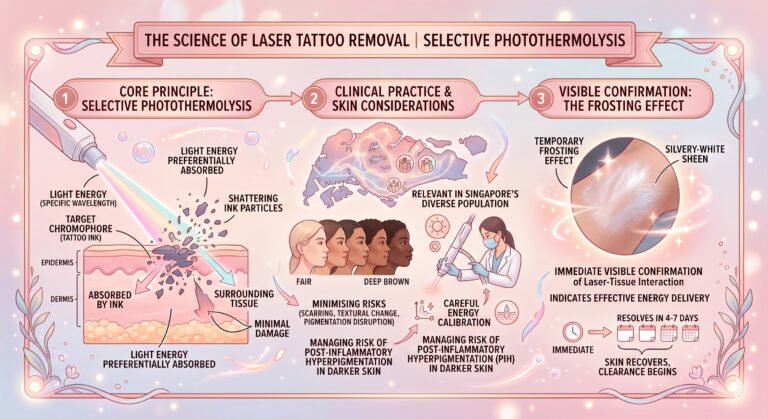
Understanding Selective Photothermolysis in Tattoo Removal
The theoretical framework underlying laser tattoo removal is selective photothermolysis — the principle that light energy of a specific wavelength will be preferentially absorbed by a target chromophore (in this case, tattoo ink) without causing equivalent damage to surrounding tissue.
In practice, this means that our doctors can deliver sufficient energy to shatter ink particles while minimising the risk of scarring, textural change, or pigmentation disruption in the surrounding skin. This is particularly relevant in Singapore, where the patient population includes skin tones ranging from fair to deep brown, and where the risk of post-inflammatory hyperpigmentation in darker skin requires careful energy calibration.
The frosting effect — a temporary silvery-white sheen that appears on the skin immediately following laser pulses — is a visible confirmation that selective photothermolysis has occurred. It represents the immediate laser-tissue interaction and indicates effective energy delivery to the ink. This frosting resolves within 4–7 days as the skin recovers and the clearance process begins.
Old Tattoos vs. Fresh Ink: What to Expect
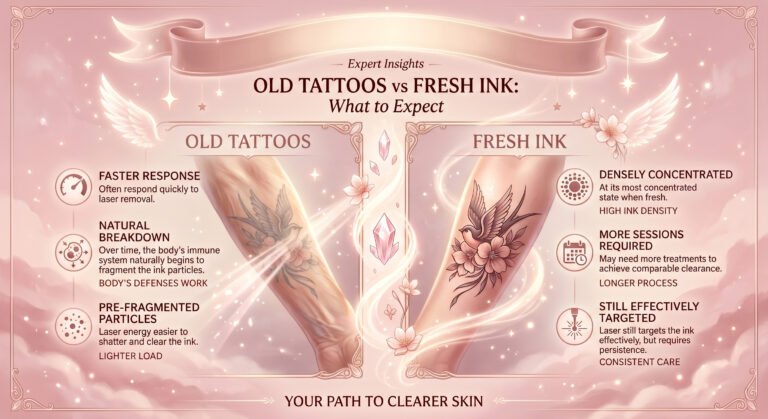
A common question at our Orchard Road clinic is whether older or newer tattoos are easier to remove. In general, older tattoos tend to respond faster to laser removal than fresh ink. Over time, the body’s immune system naturally begins to break down tattoo pigment, and the ink particles that remain are often already somewhat fragmented — making them easier for laser energy to shatter and clear.
Fresh ink is typically at its most densely concentrated state. It can still be effectively targeted, but the process may require more sessions to achieve the same degree of clearance as an aged tattoo of comparable size.
Dense, heavily saturated areas, common in tribal, sleeve, or blackwork tattoos, require more sessions than line work or lightly inked pieces. Your SW1 doctor will assess the tattoo at your consultation and provide a realistic estimate of the number of sessions likely to be required, while acknowledging that individual clearance rates vary.
After Treatment: Recovery and Supporting Skin Health
Following each tattoo removal session, the treated skin benefits from careful post-treatment management. The frosting resolves within hours, and mild redness, swelling, and sensitivity are normal in the 24–48 hours following treatment. Blistering may occasionally occur with more intensive sessions and is managed with straightforward wound care guidance from our team.
To support skin healing and minimise the risk of long-term textural change, the Scar Prevention Program at SW1 Clinic provides a structured approach to post-laser skin care, including medical-grade barrier support and monitoring between sessions.
Between sessions, LED Red Light Therapy can support tissue recovery and reduce inflammation, creating a more optimal environment for the immune clearance of shattered ink particles.
*Clinical results may vary depending on individual skin conditions and baseline health.
FAQS
How many sessions does tattoo removal take?
The number of sessions varies significantly depending on tattoo size, ink density, colour complexity, age of the tattoo, and skin type. Many patients require between 6–12 sessions for significant clearance. Your doctor will provide a personalised estimate at your consultation. Results vary.
Does tattoo removal hurt?
Most patients describe the sensation as similar to the snap of an elastic band against the skin. Topical numbing cream is applied before treatment and cold air or cooling is used during treatment to manage discomfort.
Will there be scarring?
Laser tattoo removal with selective photothermolysis technology is designed to target ink without damaging surrounding tissue. When aftercare instructions are followed, scarring risk is minimised. Some individuals with a history of keloid scarring may be at higher risk and should discuss this at consultation.
What is the "frosting" effect I've heard about?
Frosting is a temporary silvery-white sheen that appears on the skin immediately after laser pulses. It is a normal and expected sign that the treatment is working — it represents the laser-tissue interaction at the ink sites and resolves within hours to a few days.
Can you remove coloured tattoos, including blue and green ink?
Yes. SW1 Clinic’s 694nm Ruby laser is specifically designed to target blue and green ink pigments that are difficult to clear with standard wavelengths. Multi-colour tattoos require a multi-wavelength approach, which our team is equipped to provide.
Book a Consultation
Ready to clear the canvas? Book your Laser Tattoo Removal consultation now.