








SmartX
SmartX: Ablative Fractional Precision for Scars That Run Deep
Some acne scars respond to gentle persuasion. Others require a firmer conversation. Ice pick scars — the narrow, sharply defined channels that penetrate deep into the dermis — and well-established boxcar scars with steep vertical walls are among the most structurally challenging skin concerns in aesthetic medicine. They represent not just a surface irregularity but a genuine disruption of dermal architecture, and addressing them meaningfully requires a treatment that works at the depth where the damage actually lives. SmartX is that treatment: an ablative fractional CO2 laser that creates precise, controlled micro-ablations to initiate the complete reconstruction of scarred skin — from the base up.
Understanding the Scar Types SmartX Targets
Not all acne scars are the same, and recognising the distinction matters for treatment planning.
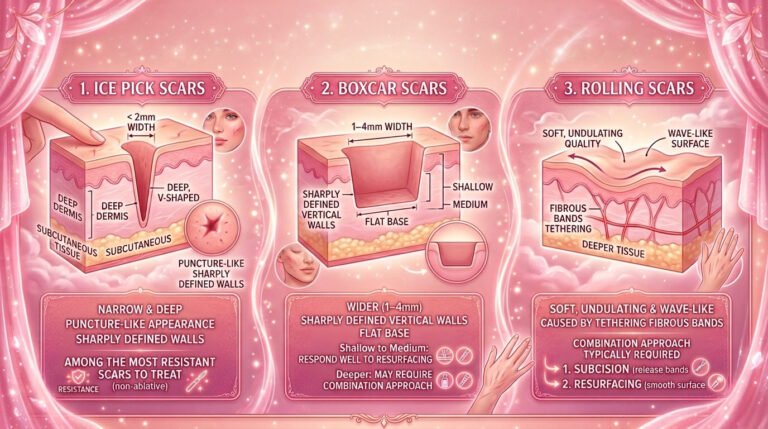
Ice pick scars are narrow (less than 2mm), deep, V-shaped channels that extend into the deep dermis or even the subcutaneous tissue. They are characterised by their sharply defined walls and their puncture-like appearance. They are among the most resistant scars to treat with non-ablative approaches.
Boxcar scars are wider (1–4mm), with sharply defined vertical walls and a flat base. Shallow to medium boxcar scars respond well to resurfacing; deeper ones may require a combination approach.
Rolling scars have a softer, undulating quality — caused by fibrous bands tethering the skin to deeper tissue and creating a wave-like surface irregularity. They typically require a combination of subcision (to release the tethering bands) and resurfacing (to smooth the surface once released).
SmartX addresses all three types — with the greatest direct impact on boxcar and moderately deep ice pick scars — by removing the scar tissue through micro-ablation and triggering the construction of new, more organised dermal architecture. “SmartX is typically the cornerstone treatment in our Scar Intervention Program,” says Dr Low Chai Ling. “It does the reconstruction work that other treatments then refine and support.”
How SmartX Works: Fractional Photothermolysis and Micro-Ablation
The mechanism behind SmartX is Fractional Photothermolysis — a principle that changed the field of laser skin resurfacing when it was introduced and remains the basis for the most effective resurfacing treatments available today. The laser beam is split into thousands of microscopic columns, creating zones of controlled, complete ablation surrounded by intact skin.
In the ablation zones, SmartX does not just heat the tissue — it removes it. Damaged, scarred, or dysplastic tissue is micro-ablated (vaporised in a precisely controlled way), creating a clean channel into which new, healthy tissue is recruited during healing. The intact skin surrounding each micro-ablation zone supplies the growth factors, fibroblasts, and epithelial cells that rebuild the treated areas.
“Micro-ablation is different from what most patients imagine when they think of laser treatment,” explains Dr Chua. “It is not burning the skin. It is a precise, controlled removal of tissue that has been structurally compromised, creating the conditions for genuinely new skin to form.”
Not sure which treatment is right for you? Take the SW1 Quick Skin Quiz — a 2-minute skin diagnostic designed by our doctors.
The Synergy of SmartX and Growth Factors
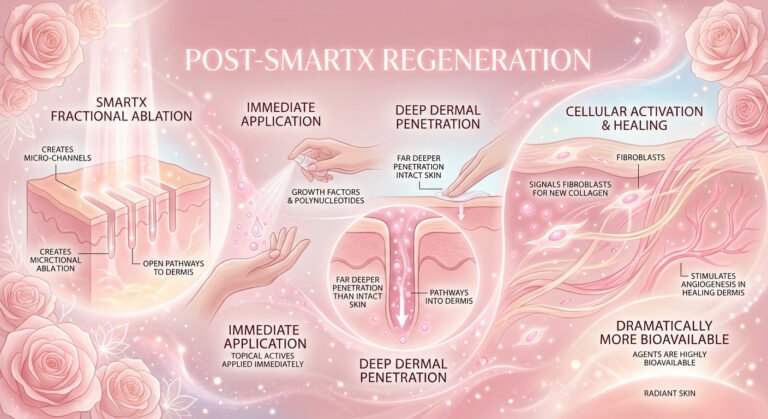
One of the more clinically elegant aspects of SmartX treatment is what happens in the hours and days following the procedure. The micro-channels created by the fractional ablation open direct pathways into the dermis — pathways through which topical actives, including growth factors and polynucleotide treatments, can penetrate far more deeply than they could through intact skin.
Applied immediately after SmartX, these agents — rich in the growth factors that signal fibroblasts to produce new collagen and stimulate angiogenesis in the healing dermis — are dramatically more bioavailable than they would otherwise be. The SmartX creates the access; the growth factors do the building work more efficiently. “We design our post-SmartX protocols specifically to take advantage of this window,” notes Dr Lee. “The treatment doesn’t end when the patient leaves the clinic — the healing phase is where much of the work happens.”
Transparent Downtime: What the Recovery Really Looks Like
SmartX is an ablative treatment — not fully ablative, but ablative nonetheless — and the recovery reflects that. Patients should expect four to seven days of visible recovery. In the first two to three days, the treatment zones form micro-crusts — small, superficial scabs over each ablated column — and the skin has a textured, sometimes bronzed appearance. The surrounding intact skin remains normal, which is why the appearance is more “micro-textured” than the uniform redness of a fully ablative laser.
Between days three and seven, the micro-crusts shed naturally as new skin forms beneath them, revealing a fresh epidermis that initially appears pink and gradually settles. Keeping the skin moisturised, avoiding sun exposure, and refraining from picking (the most important instruction of all) are the pillars of the recovery protocol.
LED Red Photomodulation is highly recommended in the recovery phase — it reduces the duration of redness, supports the integrity of the new skin, and significantly improves the patient’s experience of the post-treatment period. “Patients who do LED Red in the days after SmartX consistently report shorter, more comfortable recovery,” says Dr Low Chai Ling.
The Scar Intervention Program: SmartX as the Foundation
SmartX functions most powerfully not as a standalone treatment but as the cornerstone of a comprehensive scar revision protocol. SW1 Clinic’s Scar Intervention Program pairs SmartX with complementary treatments based on the individual’s scar types and skin characteristics. Subcision is commonly incorporated for rolling scars — releasing the tethered fibrous bands before the laser smooths the surface that is now free to rise. LED Red supports recovery. Polynucleotide treatments flood the healing dermis with growth signals. The programme treats the scar in three dimensions — depth, surface, and vascularity — rather than from a single angle.
*Clinical results may vary depending on individual skin conditions and baseline health.
FAQS
Is SmartX the right treatment for all acne scar types?
SmartX is most effective for boxcar and ice pick scars, and for overall skin resurfacing and texture improvement. Rolling scars — caused by fibrous tethering — often benefit from subcision prior to SmartX. Your SW1 doctor will assess your specific scar types and recommend the optimal sequence of treatments.
How many SmartX sessions are recommended?
Most patients require two to four sessions spaced eight to twelve weeks apart to allow for complete healing and collagen synthesis between treatments. Deeper or more extensive scarring may require additional sessions.
What is the difference between SmartX and Silk Touch?
Both are fractional CO2 lasers, but SmartX employs a more aggressive micro-ablative protocol suited to deeper scars and more significant textural correction. Silk Touch uses a gentler fractional approach appropriate for texture refinement, mild to moderate scars, and pore tightening. Your SW1 doctor will determine which is appropriate based on scar depth and type.
Can SmartX be used near the eyes or on the neck?
The treatment parameters are adjusted carefully for thinner or more sensitive areas. A consultation will determine whether the treatment is appropriate for specific anatomical areas based on individual assessment.
What skincare should I use during recovery?
A simple, gentle regime is recommended: a fragrance-free cleanser, a soothing moisturiser or barrier repair cream, and mineral SPF50 during daylight hours. Avoid exfoliating actives, retinoids, and anything that might irritate newly formed skin. Your SW1 doctor will provide a specific post-treatment protocol.
Book a Consultation
If your acne scars have been a long-standing concern affecting how you feel about your skin, SmartX offers a clinical pathway that addresses the structural problem at its source. The first step is an honest assessment of your scar types and what combination of treatments will produce the best result for your skin. The SW1 team is here for exactly that conversation.