







LED Red
LED Red Photomodulation: The Light That Heals From Within
There is something quietly extraordinary about the idea that light — specific, calibrated, completely painless light — can prompt the body to repair itself more efficiently. Red light therapy is not new science, but the clinical sophistication with which it is now applied has advanced considerably. LED Red Photomodulation at SW1 Clinic harnesses High Energy Visible (HEV) red light to trigger cellular regeneration, reduce inflammation, and restore the skin’s natural vitality — without heat, without downtime, and with a relaxation quality that most patients find rather enjoyable.
The Biological Battery: How Red Light Energises Your Cells
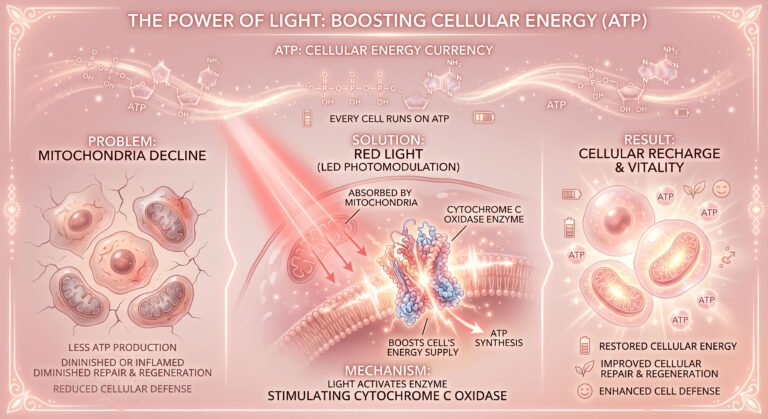
Every cell in the body runs on adenosine triphosphate — ATP — the molecular currency of cellular energy. When skin cells are stressed, inflamed, or simply ageing, their mitochondria become less efficient at producing ATP, and their capacity to repair, regenerate, and defend themselves diminishes. Red light at the wavelengths used in LED Photomodulation is absorbed directly by the mitochondria, stimulating cytochrome c oxidase — the enzyme responsible for ATP synthesis — and effectively recharging the cell’s energy supply.
Think of it as plugging in a battery that has been running low. With more ATP available, cells can repair DNA damage more effectively, produce collagen and elastin more efficiently, and mount a more robust anti-inflammatory response. The skin that emerges from a course of LED Red treatments isn’t just temporarily soothed — it is functionally more capable.
“I often describe it to patients as giving the skin a power boost,” says Dr Low Chai Ling. “We’re not adding anything foreign to the body. We’re simply helping the skin’s own machinery work better.”
Post-Laser Recovery: Speed Up Healing, Minimise Downtime
One of the most clinically valuable applications of LED Red Photomodulation is as a recovery accelerator following laser and energy-based treatments. When the skin has been treated with a resurfacing laser — Silk Touch, SmartX, or any ablative or fractional modality — the healing process that follows is active and metabolically demanding. Red light delivered immediately after such treatments supports this process in multiple ways: it reduces the inflammatory cascade, stimulates growth factor production, and boosts the keratinocyte activity that rebuilds the skin’s surface.
Patients who incorporate LED Red into their post-laser protocol consistently report shorter downtime, less redness, and a faster return to comfortable, presentable skin. “We routinely pair it with our laser treatments,” says Dr Chua. “It’s one of the simplest ways to improve the treatment experience and speed up results.”
Not sure which treatment is right for you? Take the SW1 Quick Skin Quiz — a 2-minute skin diagnostic designed by our doctors.
Barrier Repair and the Inflammation Loop
The pandemic introduced a term that has unfortunately become permanent vocabulary: maskne. Persistent friction, moisture accumulation, and the compromised skin barrier that results from extended mask wear created a wave of acne, sensitivity, and redness in people who had never had problematic skin before — and worsened existing conditions in those who had.
LED Red Photomodulation is particularly well-suited to skin caught in this kind of chronic low-grade inflammation loop. Its anti-inflammatory effects are not merely symptomatic — they interrupt the cycle at the cellular level, reducing the pro-inflammatory cytokines that perpetuate redness and irritation. For barrier repair specifically, the stimulation of keratinocyte activity helps rebuild the compromised stratum corneum that allows irritants to penetrate and moisture to escape.
“Barrier damage is underdiagnosed,” notes Dr Lee. “People come in with what they think is sensitive skin, and what’s actually happening is that their barrier is chronically depleted. LED Red is one of the gentlest, most effective ways to address that without adding more stress to the skin.”

Photobiomodulation: The Science That Unifies the Light Therapies
The umbrella term for treatments like LED Red is photobiomodulation — the use of non-ionising light to modulate biological processes. At the specific wavelengths used in LED Red Photomodulation, the primary targets are mitochondrial function, inflammatory signalling, and extracellular matrix production. The light does not heat tissue significantly; it does not damage tissue at all. It simply provides the energy stimulus that cellular machinery requires to function at its best.
This distinguishes LED Red sharply from laser treatments, which work through controlled thermal or photomechanical injury. LED Red is additive rather than ablative — it gives the skin what it needs to do a better job, rather than creating a wound that the healing process will resolve.
The Dynamic Duo: Blue and Red Together
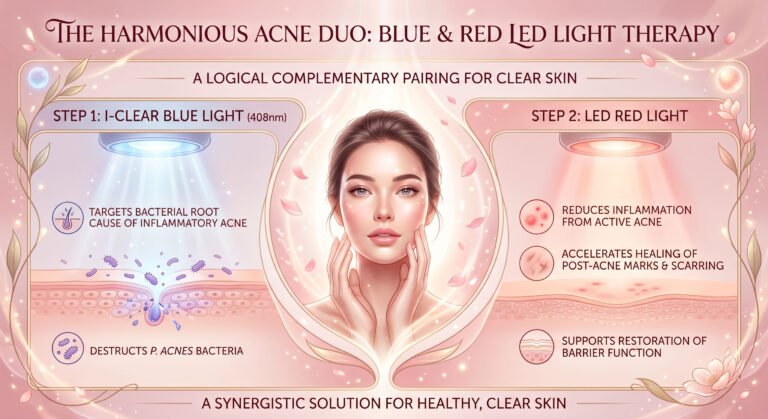
The natural companion treatment for LED Red is I-Clear blue light therapy and the pairing reflects a complementary logic that is hard to argue with. Blue light at 408nm destroys P. acnes bacteria, addressing the bacterial root cause of inflammatory acne. Red light then reduces the inflammation that active acne creates, accelerates the healing of post-acne marks, and supports the restoration of barrier function that chronic breakouts compromise.
Used together, in the same session or in alternating appointments, the two light therapies address acne from both ends of the biological chain. “Blue and red together is one of our most popular combinations for acne,” says Dr Low Chai Ling. “The results are consistently better than either one alone.”
For those ready to commit to a structured programme, SW1’s Clarity Program formalises this combination with the addition of Ultrasonic Deep Cleansing, while the Glass Skin Program incorporates LED Red within a broader rejuvenation framework.
*Clinical results may vary depending on individual skin conditions and baseline health.
FAQS
Is LED Red Photomodulation the same as an infrared sauna or home red light devices?
The therapeutic wavelengths are similar in principle, but the clinical devices used at SW1 Clinic deliver calibrated, medically validated intensities across a broad treatment area. Consumer devices typically operate at much lower intensities, making the clinical version meaningfully more effective.
Does the treatment feel like anything?
Patients describe a gentle, warm glow — pleasant rather than intense. There is no heat injury, no stinging, no vibration. Most people find the sessions deeply relaxing.
How often should I have LED Red Photomodulation?
For active inflammatory acne or post-laser recovery, twice weekly is a common initial frequency. As a maintenance and rejuvenation treatment, monthly sessions are appropriate for most patients.
Can LED Red treat hyperpigmentation and acne marks?
Red light therapy supports cellular turnover and reduces inflammation, which can help fade post-inflammatory hyperpigmentation over time. For more significant or established pigmentation, it is best combined with targeted pigment treatments and used as part of a broader skin programme.
Is there any downtime?
None. Skin may have a very mild, healthy flush immediately after treatment, which resolves quickly. You can apply makeup, go to work, and resume all normal activities immediately.
Book a Consultation
Whether you are looking to accelerate recovery from a laser treatment, calm chronically inflamed skin, or simply give your complexion the cellular recharge it deserves, LED Red Photomodulation is worth a conversation. The SW1 team can advise on how it fits within your existing or planned treatment programme.