








Silk Touch Laser
Silk Touch Laser: Where Fractional Science Meets Silky Skin
There is a particular frustration that comes with having cleared your acne — finally — only to be left with the topography it left behind. Uneven texture. Enlarged pores. The shallow craters and rough patches that catch light in all the wrong ways. Silk Touch fractional CO2 laser was designed for exactly this: not just the scars, but the full spectrum of textural irregularities that prevent skin from looking and feeling truly smooth.
The Fractional Difference: Precision Over Power
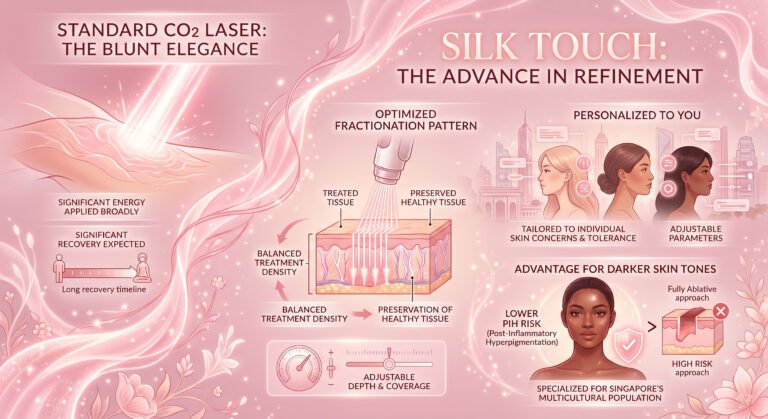
Traditional ablative CO2 lasers treat the entire surface of the skin within the treatment zone — a highly effective but demanding approach that requires extended recovery and carries a higher risk of side effects, particularly on Singapore’s diverse skin tones. Fractional CO2 technology changes the equation by dividing the laser’s energy into thousands of microscopic treatment zones, leaving the skin between those zones intact.
This “micro-zone” approach preserves a scaffold of healthy tissue throughout the treatment area. That intact tissue becomes the engine of healing — supplying growth factors, keratinocytes, and fibroblasts that migrate into the treated zones and rebuild the skin from within. The result is genuinely significant resurfacing with a fraction of the recovery burden. “Fractional is not a compromise on efficacy,” says Dr Low Chai Ling. “It is actually a more intelligent way to achieve the same result with less trauma to the patient.”
How Silk Touch Differs from Standard CO2 Lasers
Standard CO2 lasers, even when effective, operate with a blunt elegance — significant energy applied broadly, significant recovery expected. Silk Touch refines this in several important ways. The fractionation pattern is optimised to balance treatment density with preservation of healthy tissue, allowing the physician to adjust the depth and coverage to the individual patient’s skin concerns and tolerance.
For patients with darker skin tones — common in Singapore’s multicultural population — this matters enormously. Fractional CO2 carries a lower risk of post-inflammatory hyperpigmentation compared to fully ablative approaches when properly calibrated for the skin type. The treatment parameters for Silk Touch are adjusted accordingly, and the team at SW1 Clinic brings significant experience with the specific challenges of treating Asian skin. “Getting the settings right for each patient’s skin tone and scar type is where the artistry lies,” says Dr Chua. “The technology creates the possibility; the clinical judgement delivers the outcome.”
Not sure which treatment is right for you? Take the SW1 Quick Skin Quiz — a 2-minute skin diagnostic designed by our doctors.
Beyond Scars: Texture, Pores, and Orange Peel Skin
Silk Touch’s clinical applications extend well beyond what is traditionally classified as acne scarring. Enlarged pores — particularly on the nose, cheeks, and chin — respond well to the collagen remodelling that fractional CO2 stimulates. Rough, uneven texture that gives skin a bumpy or “orange peel” quality also improves meaningfully, as the laser’s energy prompts a reset of the skin’s surface architecture.
For patients who describe their skin as never quite looking smooth, regardless of how much they exfoliate or what skincare they use, Silk Touch addresses the issue at a structural level that topical products simply cannot reach. The dermis is remodelled; the epidermis is renewed; and the result is skin that does not just appear smoother but feels fundamentally different to touch.
Collagen Snap-Back: The Science of Dermal Remodelling
The clinical effect of Silk Touch operates through two mechanisms that work in tandem. The first is immediate: the laser energy causes controlled contraction of collagen fibres in the dermis, producing an instantaneous tightening that is visible as soon as the skin has settled after treatment. This “snap-back” response gives the skin a firmer, more taut quality that is perceptible from the outset.
The second mechanism is longer-term. The micro-injuries created by the fractional laser trigger the skin’s wound-healing cascade, stimulating fibroblasts to produce new collagen and elastin over the weeks and months following treatment. This neocollagenesis continues for up to six months after a session, meaning the full results emerge gradually — and patients continue to improve long after the visible recovery phase has resolved.

Understanding Downtime: What the Recovery Actually Looks Like
It would be misleading to suggest there is no recovery with Silk Touch — there is, and being transparent about it helps patients plan appropriately. In the forty-eight to seventy-two hours following treatment, the skin has a characteristic “pixelated bronzing” appearance as the microscopic treatment zones form tiny, superficial crusts. This is the healthy, expected response. The intact skin between the treated zones remains normal in appearance, which is why this texture resolves relatively quickly.
By day three to five for most patients, the bronzing has resolved and the skin has a fresh, slightly pink quality that is easily managed with mineral sunscreen and can be covered with light makeup. “I tell patients to plan for a quiet long weekend,” says Dr Lee. “It’s a few days of looking like you’ve been out in the sun a little too long — nothing alarming, very manageable.”
LED Red Photomodulation in the days immediately following Silk Touch accelerates this process and reduces redness duration, making it a highly recommended post-treatment addition.
*Clinical results may vary depending on individual skin conditions and baseline health.
FAQS
How many Silk Touch sessions will I need?
Most patients achieve their goals in two to four sessions spaced six to eight weeks apart. The number depends on scar depth, skin type, and individual healing response, all of which are assessed during consultation.
Is Silk Touch suitable for all scar types?
Silk Touch works particularly well for superficial rolling scars, enlarged pores, textural irregularities, and mild to moderate boxcar scars. Deeper ice pick scars may require additional approaches such as subcision or the SmartX laser.
How long do results last?
Results from Silk Touch are long-lasting because they reflect genuine structural improvement in the skin. However, ongoing sun protection and skin maintenance are important, as new sun damage or acne can affect the skin over time.
Can I use skincare products before and after treatment?
Your SW1 doctor will advise on pre-treatment preparation, which typically includes discontinuing certain actives (retinoids, AHAs) in the week prior. Post-treatment, a gentle, fragrance-free regime is recommended while the skin recovers.
Is there a risk of pigmentation changes in darker skin tones?
Fractional CO2 carries lower risk than fully ablative treatments, but all laser treatments require careful calibration on darker skin. The SW1 team has extensive experience treating Asian skin types and applies conservative settings with appropriate protocols to minimise this risk.
Book a Consultation
If smoother, more even skin is the goal — whether your concern is acne scarring, enlarged pores, rough texture, or a combination — Silk Touch may be the most direct route to a result you can feel as much as see. A consultation with the SW1 team will confirm whether it is the right treatment for your skin.